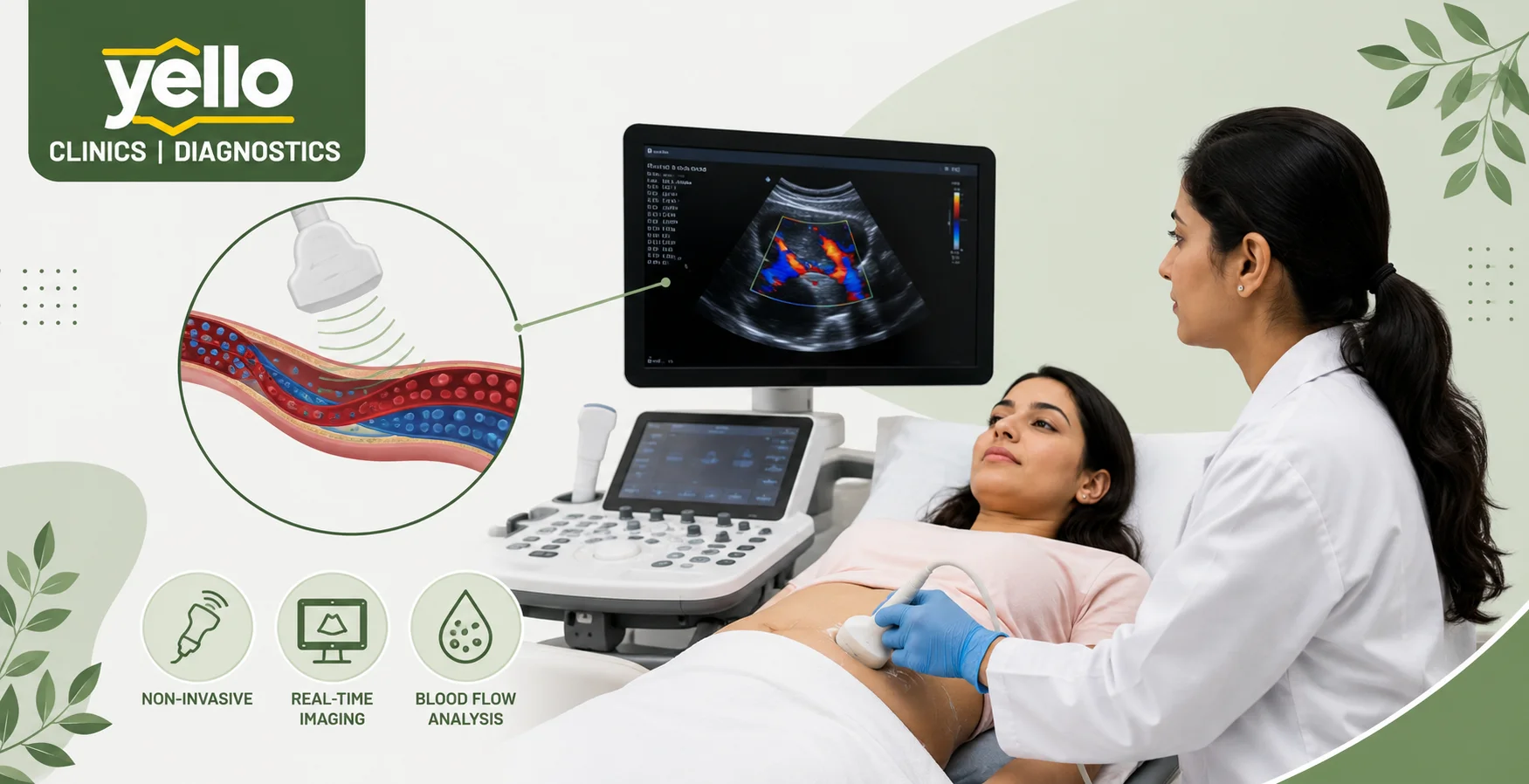
Your doctor has prescribed color Doppler ultrasound, and now you are confused about what it actually means.
Well, you are not alone. Concepts such as ‘advanced imaging’ and ‘blood flow’ can be difficult to understand.
It is basically a diagnostic test that helps visualize the flow of blood, direction, speed, and obstruction, if any. It is commonly used by doctors in case of pregnancy issues, cardiac problems, blood clots, and other organ abnormalities. It is frequently used in Color Doppler ultrasound pregnancy and often coupled with transvaginal ultrasound.
Tests of this kind are easily available in metropolitan areas like Hyderabad with the necessary infrastructure and trained professionals.
This article will provide you with all the relevant information on color Doppler ultrasound.
What Is Color Doppler Ultrasound?
The Color Doppler Ultrasound is considered an advanced type of ultrasound. Its function includes all the basic functions of an ordinary ultrasound and one more vital function, i.e., visualization of blood flow.
Regular ultrasound shows structure. You see organs. You see tissues. You see physical anatomy.
This shows movement, specifically blood movement. Red indicates blood flowing toward the probe. Blue shows blood flowing away. The color intensity reflects how fast the blood is moving.
Think of a regular ultrasound as a photograph. This is more like a video with movement data.
That difference matters. A lot. It reveals problems regular scans might miss, blood clots, blocked arteries, weak flow, or backflow. It’s also used in Color Doppler ultrasound pregnancy to monitor fetal circulation.
In some cases, a transvaginal ultrasound may be used alongside it for more detailed internal imaging.
How Does Color Doppler Ultrasound Work?
The technician applies gel to your skin. It sounds basic. The gel is crucial. It helps sound waves travel properly.
A probe (called a transducer) gets moved over the gel area. The probe sends out sound waves. These sound waves hit moving blood cells.
Here’s the physics part (made simple): when sound waves hit moving objects, the frequency changes. Fast-moving blood changes frequency more. Slow-moving blood changes frequency less. Stationary tissue doesn’t change frequency at all.
The machine detects these frequency changes. It converts them into color signals. Red, blue, yellow, green, different colors show different blood flow directions and speeds.
All these signals get converted into a color image on the screen. Doctors see blood vessels. They see how blood moves. They see if movement is normal or abnormal.
It’s real-time imaging. The medical professional can observe all activities in real-time with a Color Doppler Ultrasound.
Why Is Color Doppler Ultrasound Done?
Doctors order this test for specific reasons. They need to check blood flow. They need to see circulation. They need answers regular imaging can’t provide.
A Color Doppler Ultrasound is used when movement matters, not just structure.
Common reasons:
- To check blood flow in arteries and veins, making sure nothing’s blocked
- To detect blood clots, before they turn serious
- To evaluate heart conditions: how blood moves through the heart
- To monitor organ function, kidneys, liver, and other organs
- To assess pregnancy complications, often through Color Doppler ultrasound pregnancy
- To evaluate vascular conditions, legs, arms, neck
- To monitor dialysis access, ensuring proper function
In some instances, the procedure for transvaginal ultrasound is also considered as an additional diagnostic option.
All of these scenarios demand visualization of blood flow and not just the tissues. That is the reason why this diagnostic is ordered.
Color Doppler Ultrasound in Pregnancy
Color doppler ultrasound pregnancy is a kind of pregnancy where the doctors use this technology to keep track of blood flow and fetal health. It’s a lot more frequent, and far more significant, than most people realize. Why does it matter?
- Checks blood flow between mother and baby
- Monitors placental function
- Ensures proper fetal development
- Early detection of problems
Such Ultrasound is crucial when there are high-risk factors such as gestational diabetes, hypertension, past complications in pregnancies along with careful monitoring of fetal growth.
It provides peace of mind, even in healthy pregnancies. The presence of normal blood flow through the placenta and umbilical cord through Color Doppler ultrasound pregnancy brings true reassurance. For some early-stage cases, a transvaginal ultrasound with Color Doppler ultrasound will also be used for more detailed evaluation.
The test is safe, non-invasive and involves sound waves only, no radiation or chemicals. This is part of ordinary current prenatal care. If your doctor recommends this test, it’s not a reason to worry, it’s a step toward clarity and reassurance.
What Is Transvaginal Ultrasound?
A transvaginal ultrasound is a scan that provides a higher resolution view of the uterus, ovaries, and adjacent reproductive organs.
This method is somewhat like abdominal scans, where it produces clearer images using internal data that are not obstructed by other tissues. This makes it especially useful when accuracy matters.
When is it used?
Early pregnancy: helps detect pregnancy before it’s visible externally and may be supported with Color Doppler ultrasound pregnancy to assess blood flow
Fertility assessment: tracks ovary performance and egg growth
Pelvic Conditions: cysts, fibroids or other abnormalities
Ectopic pregnancy issues: determines if the pregnancy is in the right spot.
The doctor can combine the findings with Colour Doppler Ultrasound to determine the flow of blood and provide an overall picture of your vascular and reproductive health.
There is a normal tendency for females to be nervous about having a transvaginal ultrasound. But, it is done quickly and with the hands of a specialist tends to be more pleasant than one would think.
What Conditions Can Be Detected with Color Doppler Ultrasound?

The Color Doppler Ultrasound is able to diagnose diseases affecting the vascular system at an early stage.
- Blood clots (deep vein thrombosis) – dangerous clots moving through the body
- Blocked arteries – preventing the flow of blood to important organs
- Varicose veins – damaged veins causing swelling and visible bulges
- Heart-related issues – abnormal blood flow patterns within the heart
- Pregnancy complications – monitored through Color Doppler ultrasound pregnancy to assess placental and fetal circulation
- Organ-related blood flow issues – including kidney, liver, or pancreas conditions
- Stroke risk – evaluates blood flow to the brain
- Vascular malformations – abnormal blood vessel connections
- Weak vessel walls – areas at risk of rupture
- Decreased blood flow – inadequate circulation in various regions of the body
Sometimes, a transvaginal ultrasound might also be necessary.
This test aids in early diagnosis of issues that could otherwise lead to complications.
How to Prepare for a Color Doppler Ultrasound
Most Color Doppler ultrasound exams need minimal preparation.
Usually you just show up. No fasting required. No medications to skip. No special procedures.
But sometimes preparation matters:
- For abdominal Color Doppler Ultrasound, your doctor might ask you to fast for a few hours. Food can interfere with imaging.
- For some vascular Color Doppler Ultrasound, a full bladder might help. Yes, a full bladder. It helps with visualization of certain vessels.
- For Color Doppler ultrasound pregnancy, you might be asked to have a full bladder in early pregnancy. After the first trimester, bladder status doesn’t matter.
Ask your doctor. They’ll tell you specifically what to do before your test.
Follow instructions. Proper preparation means better images. Better images mean accurate diagnosis.
What Happens During the Procedure
You arrive. The technician explains what’s happening. You lie down comfortably on an ultrasound table.
For a regular Color Doppler Ultrasound: The technician applies conductive gel on the area being examined. The gel feels cool. That’s normal.
The probe (transducer) moves over the gel. No pressure. No pain. Just smooth movement.
You see images appearing on the screen. You might see colors, red and blue showing blood flow. You might hear sounds. Some machines produce audio representations of blood flow.
The technician might ask you to hold your breath. Might ask you to position differently. All normal. All helps get better images.
For transvaginal ultrasound specifically: The probe is smaller. The procedure is brief. Uncomfortable for some women, but not painful. Most women are surprised how quick it is. Is TVS Ultrasound Painful, the answer is usually no, it’s just slightly uncomfortable.
Duration: Color Doppler Ultrasound usually takes 20-30 minutes. Sometimes less. Sometimes more. Depends on what the doctor’s looking for.
Is Color Doppler Ultrasound Safe?

Absolutely safe!
The technique involves sound waves, not radiation. It doesn’t involve X-ray, nor CT scan, and just involves a completely safe imaging system.
It is safe for pregnant women, is safe even if done again and again, and is commonly used in various situations including color Doppler ultrasound in pregnancy. This technique is widely used by doctors for many decades and has been used successfully by millions of people without any side effects.
Its usage is controlled by medical organizations, and devices which are approved meet stringent safety guidelines.
In certain instances, a transvaginal ultrasound is performed along with this test to provide additional imaging information.
However, the only mild issue would be sensitivity towards the gel, but that’s rare and manageable.
That’s it. The test itself is safe, simple, and reliable.
When Should You Get a Color Doppler Ultrasound?
Your doctor recommending it is the #1 reason, trust their judgment.
A Color Doppler test can be especially helpful in certain situations, such as:
- During pregnancy (especially high-risk cases) – it helps monitor the baby’s development and placental function through Color Doppler ultrasound pregnancy
- If you have symptoms of poor circulation – like leg swelling, pain, skin changes, or constantly cold feet and hands
- For heart or vascular conditions – useful if you’re dealing with heart disease or blood vessel issues
- When your doctor needs a closer look – often recommended as part of a specific diagnosis
- If you have a history of blood clots – to keep track of any new risks
- If you have diabetes – to check blood flow, especially in the extremities
- Before vascular surgery – to get a clear baseline of your blood flow
In some cases, your doctor may also suggest a transvaginal ultrasound for a more detailed internal view, depending on your condition.
If your doctor recommends this test, don’t wait, early diagnosis can avert complications.
Why Choose YelloMedi for Color Doppler Ultrasound
When it comes to this test, where you go matters. Not just the machine, the people reading it too.
At YelloMedi, you get accuracy and clarity.
Why choose YelloMedi?
Advanced equipment
Modern, well-maintained Color Doppler Ultrasound machines
Experienced radiologists
They know what’s normal and what needs attention
Clear, useful reports
Easy for your doctor to understand and act on
Patient-friendly care
No rushing, proper guidance, and a comfortable experience
Need a Color Doppler Ultrasound in Hyderabad? Yello Medi is a reliable choice.
And if you’re already dealing with things like pcod vs pcos, or trying to stay consistent with a 7 day PCOS diet plan, or even just searching for the best dental clinic near me, chances are you’ll need reliable diagnostics at some point. Many people also come through a dental clinic near me that refers patients for proper imaging.
At the end of the day, accurate diagnosis makes everything easier, better treatment, better decisions, less stress. Yello Medi helps you get there.
Conclusion: What Should You Know About Color Doppler Ultrasound?
Color Doppler is one of the most advanced and accurate methods of diagnosing blood flow and any existing health problems.
This method plays an essential role in pregnancy treatment. The use of color Doppler ultrasound pregnancy allows doctors to control the process of fetus development and timely identify all possible complications, therefore it becomes a crucial component in modern medical practice.
Moreover, it would be beneficial for you to get a better understanding of your heart’s condition, as well as detecting the issue with your blood vessels. It is completely painless, risk-free, and totally safe for pregnant women; therefore, you can go through this process many times.
Sometimes, your doctor may suggest going through a transvaginal ultrasound examination. If your doctor advises to pass the color Doppler ultrasound in Hyderabad, then do not postpone visiting the doctor. Early diagnosis will help avoid complications.
Select a clinic with appropriate equipment and qualified personnel to get correct diagnoses.
Visit YelloMedi in Hyderabad for advanced diagnostics, expert interpretation, and patient-focused care.
Get reliable results with the right guidance for timely and effective treatment.
Frequently Asked Questions
What is a Color Doppler ultrasound used for?
The Color Doppler ultrasound is used to evaluate the blood vessels which includes detection of blood clots or blockage in the blood stream. Color Doppler ultrasound pregnancy is also performed to visualize fetal growth.
Is a Color Doppler ultrasound test safe for pregnancy?
Yes, Color Doppler ultrasound test during pregnancy is entirely safe. It involves the use of sound waves and not radiation.
What is the difference between ultrasound scan and Doppler ultrasound scan?
While an ultrasound image scans your internal body organs, a Color Doppler ultrasound images the blood flow in your body too.
When is transvaginal ultrasound prescribed?
Transvaginal ultrasound is prescribed for pregnancy examination, infertility issues, and other purposes.
How long does a Color Doppler ultrasound last?
Color Doppler ultrasound lasts for 20–30 minutes and is absolutely painless.

Dr. Manasa Reddy is an Obstetrician and Gynecologist at Ankura Hospital, specializing in women’s health, pregnancy care, infertility, and minimally invasive gynecological treatments.